Introduction
“The types of buying behavior in marketing explain why consumers make different purchase decisions in different situations.”
If you are an MBA student, you already know this:
Buying a phone = 10 YouTube reviews
Buying a biscuit = “jo dikha, woh uthaya”
Why does this happen?
Because not all buying decisions are the same. This is where the types of buying behavior in marketing come into play.
And once you understand this, you’ll start seeing marketing everywhere — even in your next grocery run.
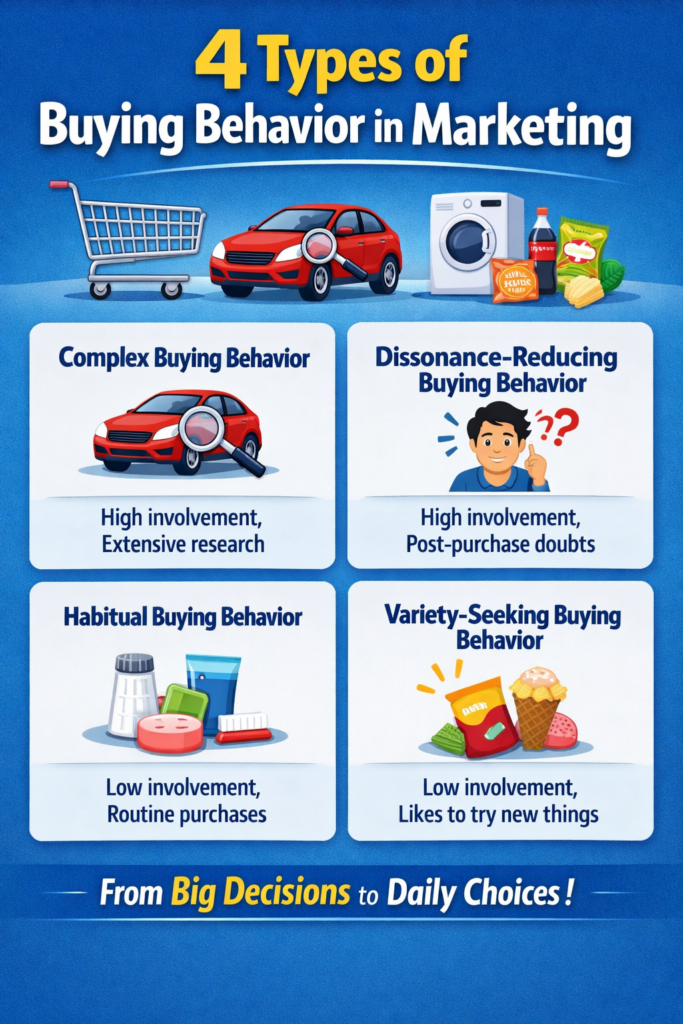
What are the Types of Buying Behavior in Marketing?
Buying behavior refers to how consumers make decisions.
It mainly depends on:
- How involved the consumer is
- How different the brands appear
Based on this, there are four types of buying behavior.
Understanding the types of buying behavior helps marketers design better strategies.
1. Complex Buying Behavior
This is when:
- The purchase is expensive
- The risk is high
- The consumer is deeply involved
Think of buying a car.
You don’t just walk into a showroom and say:
“Bhaiya, jo sabse zyada bikta hai, woh de do.”
Instead, you:
- Compare features
- Watch reviews
- Ask friends
- Negotiate like a pro
Example with Tagline:
Tata Motors – “Connecting Aspirations”
These brands don’t just sell cars — they sell trust and aspiration.
Class insight:
High involvement = detailed ads, emotional + rational mix.
2. Dissonance-Reducing Buying Behavior
This is where things get interesting.
- High involvement
- But brands look very similar
You buy… but then comes the classic thought:
“Did I make the right choice?”
Example:
Buying a washing machine or insurance
After purchase, you suddenly become an expert:
- Watching reviews AFTER buying
- Asking others “tumne kaunsa liya?”
Example with Tagline:
LIC – “Zindagi ke saath bhi, Zindagi ke baad bhi”
This tagline works because it reduces anxiety and builds reassurance.
Class insight:
Here, marketing doesn’t stop after selling — it continues to reassure.
3. Habitual Buying Behavior
This is the easiest one.
- Low involvement
- No major brand difference
You don’t think. You just pick.
Example:
Buying salt, soap, or toothpaste
You don’t stand in the store thinking:
“Let me analyze sodium chloride composition today.”
Example with Taglines:
Tata Salt – “Desh ka Namak”
Colgate – “Daant strong, toh main strong”
These brands rely on:
- Habit
- Repetition
- Recall
Class insight:
Here, advertising is not about convincing — it’s about reminding.
4. Variety-Seeking Buying Behavior
This is the fun category.
- Low involvement
- But you WANT to try something new
Example:
Snacks, biscuits, beverages
You don’t switch because you’re unhappy.
You switch because:
“Yaar, kuch naya try karte hain.”
Example with Taglines:
Kurkure – “Tedha hai par mera hai”
Lays – “No one can eat just one”
These brands:
- Launch new flavors
- Experiment constantly
Class insight:
Consumers here are not loyal — they are curious.
Why This Matters for MBA Students
This concept is everywhere:
- Case studies
- Exams
- Real-world marketing
Next time you see an ad, ask yourself:
“Which buying behavior is this targeting?”
That’s when marketing actually starts making sense.
Connection with Other Concepts
Buying behavior directly affects:
High involvement products need strong positioning.
Low involvement products need strong recall.
Conclusion
The types of buying behavior may look simple in theory, but they explain a lot about real-world consumer decisions.
Once you understand this, you won’t just study marketing — you’ll start observing it in daily life.
And that’s where the real learning begins.

Professor of Marketing at Jaipuria Institute of Management, Lucknow. Ph.D. in Marketing, IIM Lucknow. Ex-assistant Prof at IIM Ranchi, visiting faculty to IIM Lucknow. Writes for ET BrandEquity, Campaign India, BusinessWorld, Times of India etc.