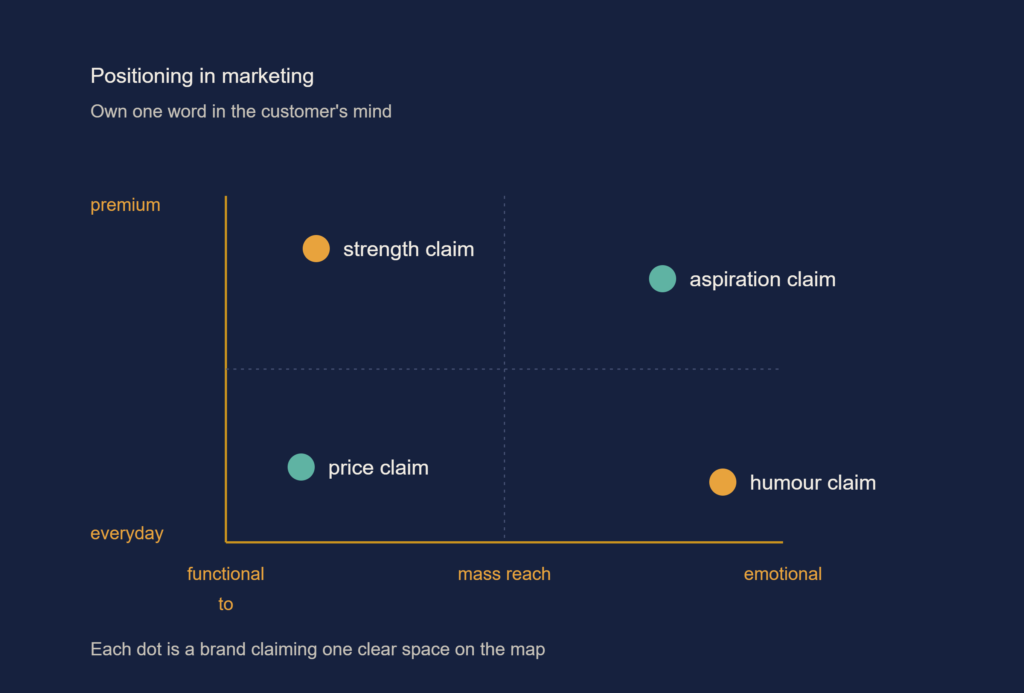
What is Brand Positioning in Marketing
(Last updated: September 2026)
Brand positioning in the marketing is the process by which a company creates a distinct image and identity for its product, service, or brand in the minds of consumers. In simple words, positioning answers an important question: what is the first thing people think about when they hear a brand name?
Every successful brand occupies a unique space in the consumer’s mind. This space is built through consistent messaging, advertising, product features, and brand experiences.
Positioning in marketing is the process by which a brand creates a distinct image in the minds of consumers, so that when people think of a category, one specific brand comes to mind first. It answers one simple question: what is the first word people associate with your brand name?
This isn’t decided by the company. It’s decided in the customer’s head, built through consistent messaging, advertising, product experience, and communication over time.
A Quick Exercise: Test Positioning for Yourself
Think of the first word that comes to mind for these brands:
| Brand | What People Think |
|---|---|
| Maruti | Value for money, affordability, mileage |
| ThumsUp | Adventure, thrill |
| Tata | Trust |
That instant mental association is positioning at work. It was popularized by Jack Trout and Al Ries in their book Positioning: The Battle for Your Mind, which argued that brands compete as much inside the consumer’s mind as they do in the market.
Positioning is the final step in the sequence of Segmentation, Targeting, and Positioning (STP) — and it’s also one of the most misunderstood concepts in marketing, often confused with something much narrower: a tagline.
Positioning vs. Tagline
A tagline is not positioning. It’s a communication tool that reinforces positioning.
ThumsUp’s tagline is “Taste the Thunder” — but the brand’s actual positioning is built around adventure, thrill, and masculinity. The tagline supports that positioning; it isn’t the positioning itself.
7 Positioning Strategies, With Indian Examples
1. Preemptive positioning — being the first to claim a specific benefit.
Colgate Salt positioned itself as the first toothpaste with salt, claiming that attribute before any competitor could.
2. Umbrella positioning — one benefit applied across an entire product line.
LIC’s “Zindagi ke saath bhi, zindagi ke baad bhi” covers its full range of policies under a single emotional promise.
3. Premium positioning — built on exclusivity and luxury.
BMW, Gucci, and Armani all compete on this axis rather than price.
4. Positioning against the competition — defined directly in contrast to a rival.
Patanjali Dantkanti positioned itself against Colgate on a desi (homegrown) versus videshi (foreign) narrative.
5. Attribute-based positioning — owning one specific, provable feature.
Dettol owns “kills 99.9% germs.” Sebamed positioned its soap against market leaders purely on pH value. Intel built decades of trust around its processor badge.
6. Unowned attribute positioning — claiming space competitors left open.
Most Indian deodorant brands positioned around attraction and sexist advertising. Fogg broke that pattern entirely, positioning on “no gas” and spray count — durability nobody else was claiming — and it overtook market leader Axe.
7. Repositioning — refreshing identity as consumer relevance fades.
Airtel and Lifebuoy both changed logos, colors, and messaging over the years to stay relevant to new generations of consumers. Few remember Lifebuoy’s original red soap and its jingle, “Tandurusti ki Raksha Karta Lifebuoy” — proof that even strong positioning needs refreshing over time.
How to Identify Any Brand’s Positioning
A quick way to reverse-engineer a brand’s strategy:
- What single word would a loyal customer use to describe it instantly
- Which competitor is it clearly avoiding a direct price or feature fight with
- Has its core message stayed consistent for years, or shifted often
Brands with the strongest positioning almost always score well on that last point. Positioning built over years is far harder for competitors to copy than positioning built around one campaign.
Positioning and the Bigger Picture: STP and BCG Matrix
Positioning doesn’t happen alone — it’s the output of Segmentation and Targeting done well. A brand can’t position itself convincingly to “everyone,” because different segments value different things. It’s also worth separating positioning from the BCG Matrix, which classifies a company’s products by market share and growth to guide investment decisions. A “Star” product in the BCG Matrix still needs strong positioning to stay one — the two frameworks operate at different levels but inform each other.
Final Takeaway
Positioning is not a slogan or a logo. It’s the one idea a brand is willing to repeat, sacrifice other messaging for, and defend for years, until it becomes the automatic answer in a customer’s mind.

Professor of Marketing at Jaipuria Institute of Management, Lucknow. Ph.D. in Marketing, IIM Lucknow. Ex-assistant Prof at IIM Ranchi, visiting faculty to IIM Lucknow. Writes for ET BrandEquity, Campaign India, BusinessWorld, Times of India etc.