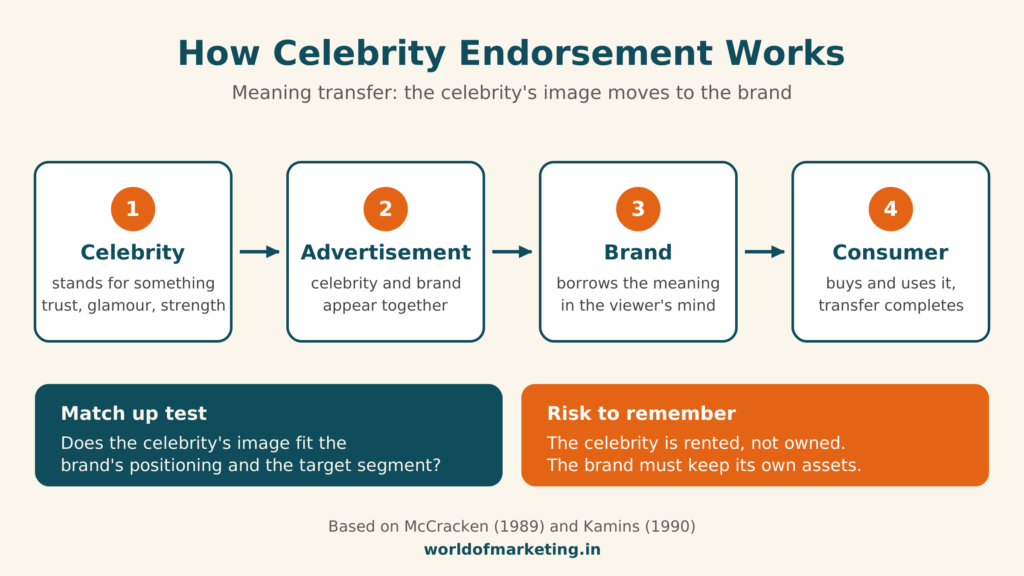
Celebrity endorsement in advertising is one of the most expensive decisions a marketing team makes, and one of the least understood. A famous face can rescue trust, borrow glamour or sell a forgettable product. It can also drag a brand into a crisis it did not create. This post explains how it works, with two Indian cases you can use in an exam or an interview.
Last updated: November 2026
What Celebrity Endorsement in Advertising Means
Celebrity endorsement in advertising is the use of a well known person to promote a brand, so that the audience links the person’s image with the product. The celebrity is not just a messenger. In effect, they become part of the brand’s positioning.
Two ideas explain why it works. The first is the match up hypothesis. Research by Michael Kamins (1990) is cited for the finding that attitude toward an ad improves when the celebrity’s attributes fit the brand. A trustworthy actor suits a trust led category, for instance, while a sports star suits a performance product.
The second is meaning transfer, proposed by Grant McCracken (1989). The celebrity stands for something in the public mind, built through films, sport or television. When the celebrity appears with a product in an ad, that meaning moves across to the product. McCracken argued that the transfer completes when the consumer buys or uses the product. Both ideas are summarised in a working paper by Seema Gupta and Satish Pandey, published by IIM Bangalore.
I ask my MBA students a simple question: when you see a celebrity in an ad, are you remembering the product or the person? Most admit it is the person. That gap is the central risk of this strategy.
Indian Examples: Cadbury and Maggi
Cadbury Dairy Milk and Amitabh Bachchan. In October 2003, worms were reported in Cadbury Dairy Milk bars sold in certain shops in Kerala and Maharashtra. According to Business Standard (July 2004), Cadbury’s value share fell from 73% in October 2003 to 69.4% in January 2004, then recovered to 71% by May 2004. The company also added a sealed plastic wrapper inside the foil.
Amitabh Bachchan featured in the communication. A Cadbury India executive told the paper: “The big factor that has pushed up CDM sales is the Amitabh Bachchan campaign.” That is the company’s own view, not independent proof. Still, it shows the logic: when trust is the problem, a person the public already trusts is a fast signal.
Maggi and its endorsers. The risk side appeared in June 2015. As BestMediaInfo reported, a Bihar court ordered an FIR against Amitabh Bachchan, Madhuri Dixit and Preity Zinta over Maggi endorsements, and Madhuri Dixit also received a notice from the Haridwar food and drug authority. Industry voices quoted in the article, including KV Sridhar of SapientNitro India, called holding celebrities responsible unfair. Others noted that endorsers expect indemnity clauses in their contracts.
Together, the two cases show the same asset working in two directions. The face that helped Cadbury rebuild trust became a legal and reputational exposure for others.
Celebrity Endorsement in Advertising and Other Frameworks
Endorsement is not a strategy by itself. It sits inside larger frameworks.
- Positioning: The celebrity should reinforce the one idea the brand owns. Read my guide to brand positioning in marketing first, because an endorser who contradicts the positioning confuses the buyer.
- STP: The right endorser depends on the target segment. A face that appeals to one group may mean nothing to another. My post on the STP model in marketing covers this.
- Brand assets: A celebrity is rented, not owned. A tagline stays with the brand, as my post on the Fevicol tagline in Hindi shows.
- Frequency: Heavy repetition of one face can tire an audience, which I discuss in my post on the Foxtale Shah Rukh Khan ad.
Think Like a Marketer
- Which matters more for a brand: a celebrity who fits the product, or one who is simply the most famous?
- Cadbury’s executive credited the campaign for the recovery. What other factors might have helped?
- Who should carry the risk when an endorsed product fails: the brand, the celebrity or the agency?
- Can a brand with a strong character or tagline do without a celebrity entirely?
How to Use Celebrity Endorsement in Advertising in Placement Interviews
Likely question: “Would you recommend a celebrity for this brand’s launch?”
How to answer: Start with the objective: awareness, trust or aspiration. Apply the match up test and the meaning transfer logic, then name the risks: cost, overshadowing the brand and reputational exposure. End with a clear recommendation and a condition, for example “yes, if the endorser’s image fits our positioning”.
Bonus tip: Mention both a success and a risk example, such as Cadbury and Maggi. It shows balance.
Final Takeaway
A celebrity can lend a brand trust or glamour, but only the brand can keep it.

Professor of Marketing at Jaipuria Institute of Management, Lucknow. Ph.D. in Marketing, IIM Lucknow. Ex-assistant Prof at IIM Ranchi, visiting faculty to IIM Lucknow. Writes for ET BrandEquity, Campaign India, BusinessWorld, Times of India etc.