Introduction
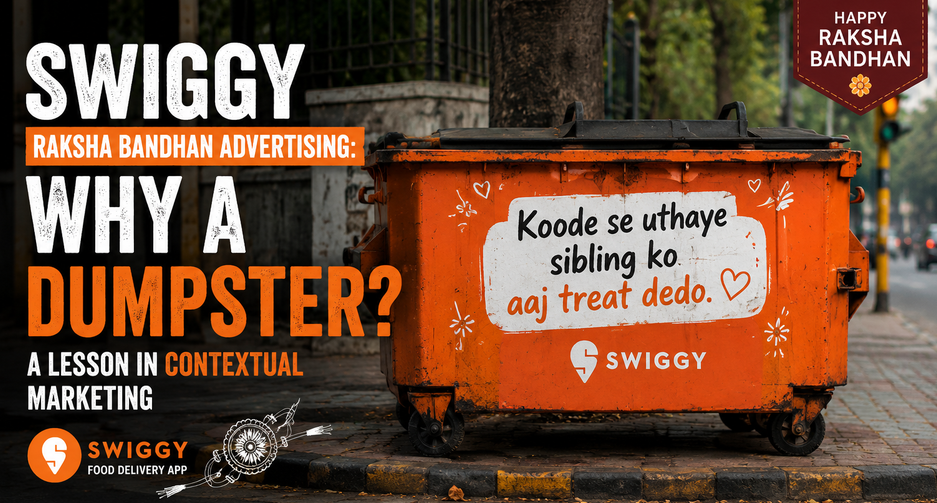
Swiggy Raksha Bandhan Advertising is a useful case study in contextual marketing. Instead of putting another sentimental sibling message on a conventional billboard, Swiggy turned an oversized orange dumpster into the advertisement itself, using the line, “Koode se uthaye sibling ko aaj treat dedo.” The joke is familiar, but the placement makes it work.
What Happened?
For Raksha Bandhan, Swiggy took one of the most predictable sibling jokes in Indian households and gave it a physical form.
The message roughly plays on the childhood taunt that your sibling was picked up from the garbage. Swiggy then placed that thought literally on a dumpster and followed it with a simple proposition: now that it is Rakhi, treat your sibling.
The campaign has been described as an OOH execution rather than a conventional billboard campaign. The dumpster itself becomes the canvas, making the physical environment part of the creative idea.
That distinction matters.
Swiggy Raksha Bandhan Advertising: The Medium Is Doing Some of the Work
The primary marketing concept here is Contextual Marketing.
Imagine the same copy printed in a newspaper:
“Koode se uthaye sibling ko aaj treat dedo.”
It would still be understandable. It might even be funny.
But something would be missing.
Now put the exact line on a dumpster.
Suddenly, the word “koode” has a physical reference. The environment supplies part of the punchline.
This is where the campaign becomes interesting from a marketing perspective.
A lot of advertising uses a medium as a delivery mechanism. This campaign uses the medium as part of the message.
That is a useful distinction for anyone studying OOH Advertising.
A large billboard can give you visibility. A relevant physical location can give you meaning.
The campaign also fits Swiggy’s conversational style. Rather than explaining sibling love, it taps into the slightly ridiculous way siblings actually communicate. Public reactions on LinkedIn repeatedly focused on this combination of familiar sibling teasing, humour and physical context.
And that is probably the stronger consumer insight.
Raksha Bandhan is often portrayed in advertising through affection, nostalgia and emotional music.
Swiggy went somewhere more ordinary.
Siblings irritate each other. Then they feed each other.
That feels closer to everyday sibling behaviour.
What About Print Advertising?
This is where the campaign becomes particularly useful for an advertising-focused website.
The execution itself is OOH, not Print Advertising. But comparing it with print helps explain why the idea works.
A print advertisement has to create its own context inside the page. A newspaper ad can use headlines, visuals, typography and surrounding editorial content to build meaning.
OOH has another advantage: the real world can become part of the creative.
That gives marketers a useful question:
If this same Swiggy idea had appeared as a newspaper advertisement, what would have replaced the dumpster?
Perhaps the answer would be a visual of a sibling emerging from a dustbin. Perhaps a newspaper page could have been designed like a sibling’s childhood “complaint sheet.”
But those executions would be illustrating the joke.
The OOH execution makes the joke physically real.
That is the difference.
For a site that studies Indian Print Advertising, this is an important reminder that the medium itself can change the effectiveness of an idea. The best advertising case studies are not always about choosing one medium over another. They are about understanding what each medium allows the brand to do.
Think Like a Marketer
Ask yourself:
Would this idea be equally effective on a normal billboard?
Would it work as a newspaper advertisement?
Is the humour coming from the copy, the context, or the combination of both?
And perhaps the most important question:
Did Swiggy find an unusual medium because the idea demanded it, or does the unusual medium make an ordinary joke feel smarter?
That is a much better classroom debate than simply calling the campaign “creative.”
How to Use Swiggy Raksha Bandhan Advertising in Placement Interviews
Typical Interview Question:
What is contextual marketing?
How You Can Answer:
Contextual marketing connects the advertising message with the environment in which consumers encounter it. Swiggy’s Raksha Bandhan campaign is a good example because the dumpster is not merely the advertising space. It reinforces the meaning of the copy and completes the joke.
Bonus Interview Tip:
Don’t just say “the ad is creative.” Explain what role the medium plays in making the communication stronger.
Final Takeaway
Sometimes the smartest advertising idea is not a better message. It is finding the place where the message makes sense.

Professor of Marketing at Jaipuria Institute of Management, Lucknow. Ph.D. in Marketing, IIM Lucknow. Ex-assistant Prof at IIM Ranchi, visiting faculty to IIM Lucknow. Writes for ET BrandEquity, Campaign India, BusinessWorld, Times of India etc.