Introduction
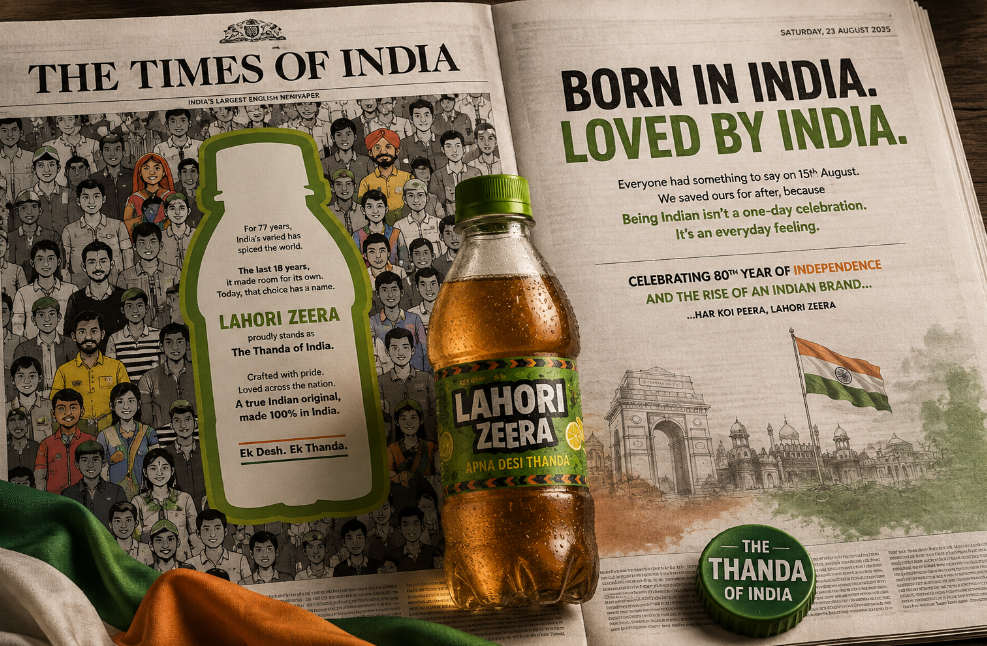
Lahori Zeera Print Advertising is doing something more ambitious than selling a bottle of jeera drink. Its latest The Times of India takeover uses Independence Day, Indian identity and the familiar word “thanda” to ask a much bigger question: can a challenger brand enter territory once strongly associated with Coca-Cola? The advertisement says, “Born in India. Loved by India” and positions Lahori Zeera as “The Thanda of India.”
Marketing Lesson: Challenger Brand Strategy
The central marketing lesson here is challenger brand strategy.
A challenger brand does not have the same advertising budgets, distribution power or historical brand equity as the market leader. So simply copying the leader’s playbook can be a losing game.
Lahori Zeera appears to be taking a different route.
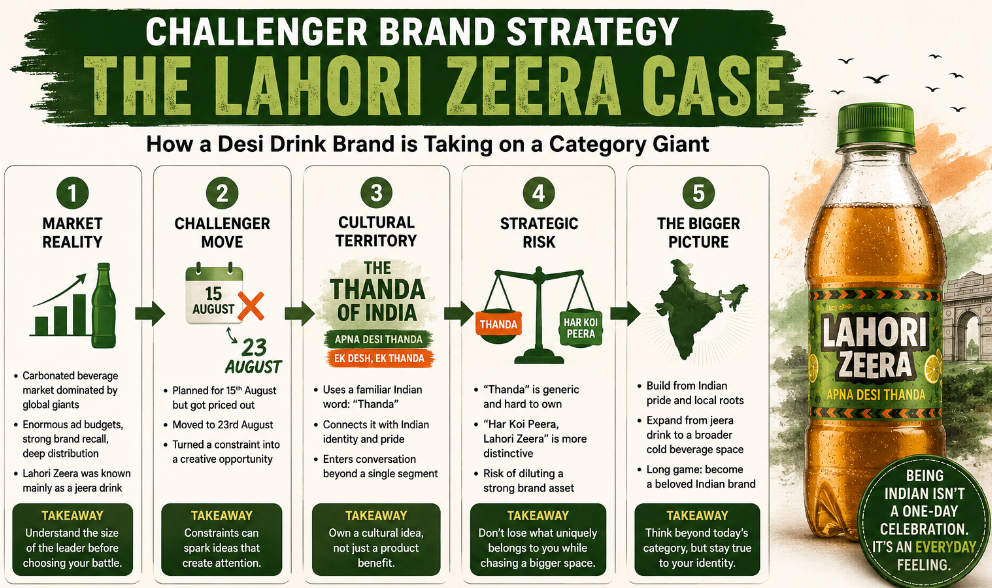
The campaign was originally planned for August 15, but the brand says crowded Independence Day advertising inventory and higher rates pushed it to August 23. Instead of treating that as a problem, Lahori turned the delay into part of the communication. The message was essentially that being Indian is not something that needs to be celebrated on only one day.
That is clever media thinking.
The brand did not win the August 15 spending battle. Instead, it found a way to remain part of the Independence Day conversation after the advertising noise had reduced.
That matters because challenger brands often have to convert constraints into creative advantages.
The second, and more interesting, move is the attempt to claim “thanda.”
Indian advertising students will immediately remember Coca-Cola‘s famous “Thanda Matlab Coca-Cola” platform. Coca-Cola deliberately connected the everyday Hindi word for a cold drink with its brand. More than two decades later, Lahori Zeera is entering similar linguistic territory with “The Thanda of India” and “Apna Desi Thanda.”
But there is an important strategic difference.
Coca-Cola was trying to make “thanda” mean Coca-Cola.
Lahori Zeera is trying to make “thanda” feel desi and Indian.
That distinction makes the advertisement more than a clever newspaper headline. It is an attempt to move from being known primarily for jeera soda toward becoming a broader participant in India’s cold beverage category.
And that is where the strategy becomes interesting for MBA students.
A challenger does not always need to own the biggest category asset immediately. It can first create a distinctive association around a cultural idea, then repeatedly connect that idea to the brand.
The risk, however, is obvious.
“Thanda” is a generic word. Marketing consultant Ashok Lalla has questioned whether it is distinctive enough for Lahori Zeera to own over the long term, while pointing to “Har Koi Peera, Lahori Zeera” as a more uniquely identifiable brand asset.
That creates a genuine strategic tension.
Should Lahori Zeera keep building a phrase that consumers can immediately connect to the brand, or should it attempt a much larger category association?
This is the classic challenger-brand dilemma: build what you uniquely own, or compete for what everyone wants.
The print medium also matters. A full newspaper takeover gives the brand a stage large enough to make a category-level statement. This is very different from a short digital advertisement fighting for attention among hundreds of competing posts.
In other words, the newspaper is not simply carrying the message.
It is helping make the message feel like a declaration.
And there is a little irony here. A brand that was priced out of the biggest advertising day may have ended up with a more interesting story precisely because it arrived late.
Think Like a Marketer
Ask yourself three questions.
If you were Lahori Zeera, would you try to own “thanda”?
Would you prioritise “Har Koi Peera, Lahori Zeera” because it is more distinctive?
And can a challenger brand successfully borrow a familiar category word without being overshadowed by the brand that historically owned the association?
There is no easy answer.
That is what makes this a useful classroom case.
How to Use This in Placement Interviews
Typical Interview Question:
How can a challenger brand compete with a much larger market leader?
How You Can Answer:
A challenger can avoid competing purely on media spending and instead use distinctive positioning, cultural relevance and creative use of constraints. Lahori Zeera’s print campaign demonstrates this by turning a missed Independence Day media opportunity into a positioning statement while attempting to associate “thanda” with its Indian identity.
Bonus Interview Tip:
Don’t say, “The advertisement is creative.” Explain why the creativity solves a business problem.
Final Takeaway
A challenger does not always need the biggest budget; sometimes it needs a bigger idea than the budget can buy.

Professor of Marketing at Jaipuria Institute of Management, Lucknow. Ph.D. in Marketing, IIM Lucknow. Ex-assistant Prof at IIM Ranchi, visiting faculty to IIM Lucknow. Writes for ET BrandEquity, Campaign India, BusinessWorld, Times of India etc.