Introduction
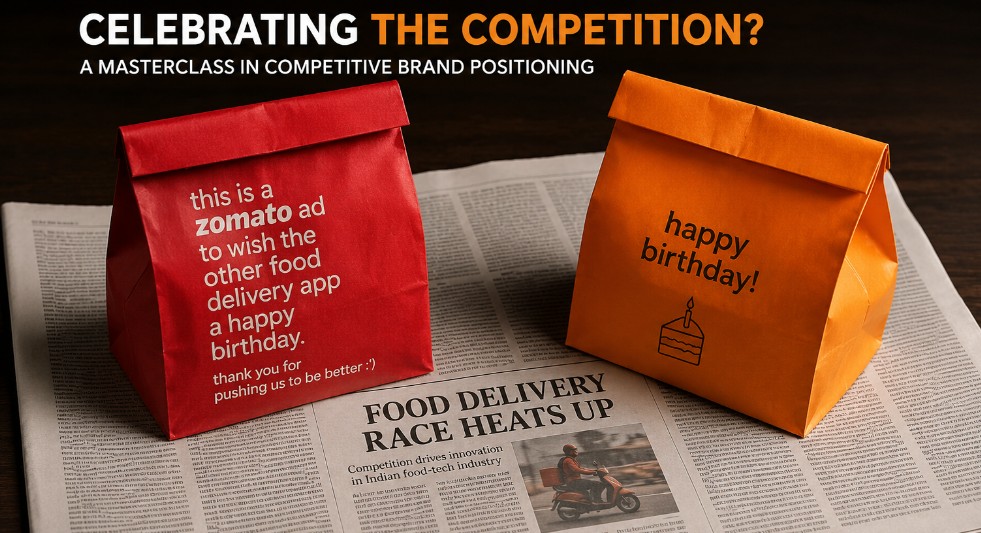
The latest Zomato Print Advertising campaign raises an interesting question. Why would a market leader spend money on a newspaper advertisement that wishes its biggest rival a happy birthday? At first glance, it looks like an unusual act of corporate generosity. But marketers know that advertisements are rarely created without a strategic objective. Behind this minimalist newspaper advertisement lies an important lesson in competitive brand positioning and how confident brands use rivalry to strengthen their own identity.
Marketing Lesson
Every advertising campaign should begin with one question: What business objective is the brand trying to achieve?
In this case, Zomato wasn’t trying to increase food orders through a promotional offer. Instead, it used Print Advertising to reinforce its brand personality.
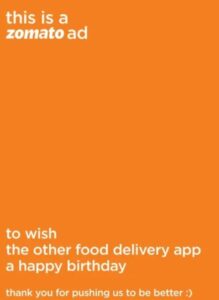
The newspaper advertisement simply wished “the other food delivery app” a happy birthday. Swiggy’s name never appeared. Instead, the advertisement used Swiggy’s signature orange colour while maintaining Zomato’s distinctive conversational tone. Ironically, the advertisement became as much about Zomato as it was about its competitor.
This demonstrates the marketing concept of Competitive Brand Positioning.
Strong brands don’t always compete by attacking rivals. Sometimes they acknowledge competitors in ways that make consumers appreciate the category and the confidence of the brand itself. Public recognition can signal leadership because only established brands can afford to appear secure enough to celebrate competition.
This is not a new advertising strategy. Mercedes-Benz famously congratulated BMW on its centenary with the witty line, “Thanks for 100 years of competition. The previous 30 years were a bit boring.” The advertisement celebrated BMW while subtly reminding readers that Mercedes had been around even longer. The campaign strengthened Mercedes’ own positioning rather than weakening it.
Indian advertising has increasingly adopted similar tactics. Brands such as Blinkit and Zepto, Pepsi and Coca-Cola, and now Zomato and Swiggy have shown that healthy rivalry often attracts more attention than conventional product-focused campaigns.
The choice of Print Advertising is equally significant. Newspaper advertisements continue to offer credibility and cultural relevance, especially when a brand wants to create a public statement rather than drive immediate transactions. While digital advertising delivers speed and targeting, print advertising often creates moments that people discuss across social media, giving one medium the power to amplify another.
If you’ve ever congratulated a friend while secretly hoping everyone notices your generosity, you’ve already experienced the psychology behind this campaign.
Think Like a Marketer
Would this advertisement have generated the same attention if it had appeared only on Instagram?
Would consumers have appreciated the gesture if Zomato had mentioned Swiggy’s name directly?
Or did the subtle copy, newspaper format and restrained execution make the campaign more memorable?
These are the questions marketers should ask before deciding whether a campaign succeeded. Some Memorable Indian Advertisements.
How to Use This in Placement Interviews
Typical Interview Question
Why would a brand advertise its competitor instead of promoting its own products?
How You Can Answer
A confident market leader may use competitive advertising to strengthen brand positioning rather than generate immediate sales. By publicly acknowledging a rival, the brand demonstrates category leadership, reinforces its personality and generates conversations that extend beyond the original advertisement. Zomato’s print campaign is a good example of how advertising can build brand perception without directly selling a product.
Bonus Interview Tip
Differentiate between comparative advertising and competitive brand positioning. The first compares products, while the second uses rivalry to strengthen brand identity.
Final Takeaway
Sometimes the most powerful advertisement isn’t about defeating a competitor. It’s about showing consumers that your brand is confident enough to celebrate one.

Professor of Marketing at Jaipuria Institute of Management, Lucknow. Ph.D. in Marketing, IIM Lucknow. Ex-assistant Prof at IIM Ranchi, visiting faculty to IIM Lucknow. Writes for ET BrandEquity, Campaign India, BusinessWorld, Times of India etc.