Introduction
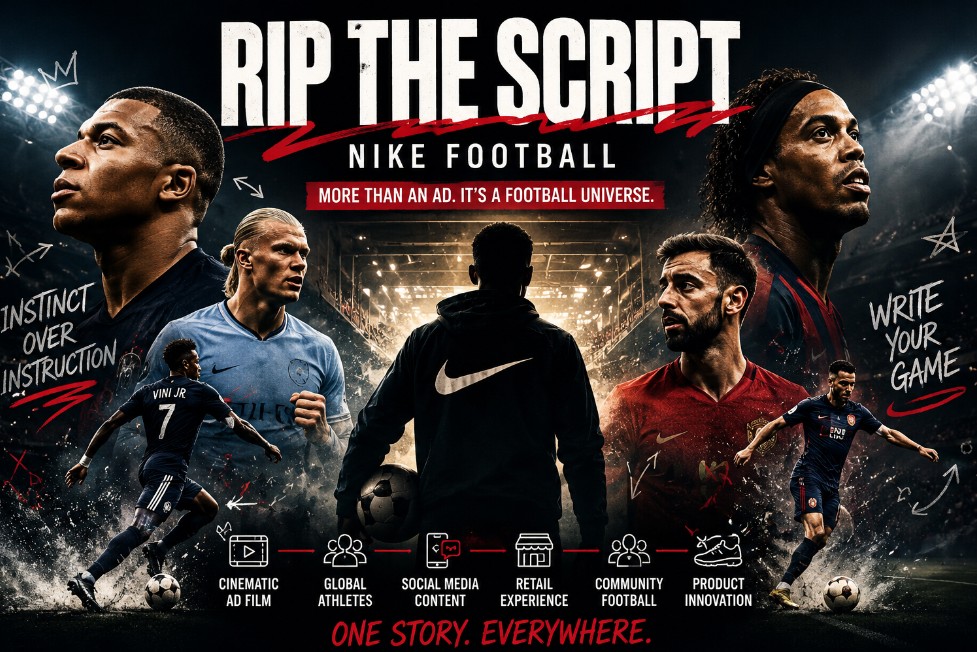
The Nike Rip the Script advertising campaign isn’t just another football commercial packed with global superstars. At first glance, it looks like a high-energy film featuring players such as Kylian Mbappé, Erling Haaland, Vinícius Júnior and legends like Ronaldinho. But look closer, and a different question emerges. Why would Nike invest in a cinematic campaign that spends more time celebrating football culture than promoting a specific product?
The answer lies in a powerful marketing concept: Integrated Brand Storytelling. Instead of asking consumers to buy a pair of boots, Nike invites them into an entire football universe where the brand represents creativity, confidence and self-expression.
Marketing Lesson
Every successful advertising campaign starts with a business objective. In Nike’s case, the objective wasn’t simply to launch a new football product. It was to strengthen Nike Football as a cultural movement.
The campaign revolves around one central idea: football should be played with instinct rather than following a predictable script. This message is reflected not only in the film but also across Nike’s products, athlete partnerships, digital content and community initiatives. The advertisement becomes the opening chapter of a much larger story.
This is what marketers call Integrated Brand Storytelling.
Rather than treating advertising as a standalone activity, Nike connects every consumer touchpoint around one consistent narrative. Whether someone watches the campaign on YouTube, follows their favourite footballer on social media or visits a Nike store, they encounter the same message. Each interaction reinforces the others.
Many brands make the mistake of believing a single viral advertisement is enough to build long-term brand value. In reality, memorable brands create connected experiences. The advertisement creates awareness, but the wider ecosystem builds emotional attachment.
Think about it this way. Watching the campaign is like watching the trailer for a blockbuster movie. The trailer creates excitement, but the experience continues through merchandise, fan communities, behind-the-scenes content and future releases. Nike applies the same principle to its football business.
This approach also explains why the campaign features multiple athletes rather than focusing on one celebrity. The stars are not the message. They are storytellers representing different expressions of football, united by one brand philosophy.
Social Media Pulse
Public reaction to the campaign suggests that Nike successfully generated conversation, although opinions were divided on execution.
| Theme | Observation |
|---|---|
| Positive | Many viewers praised the return of Nike’s cinematic football storytelling and compared it with classic campaigns such as Write the Future and Joga Bonito. |
| Negative | Some felt the advertisement relied too heavily on celebrity appearances and lacked the emotional impact of Nike’s earlier football films. |
| Balanced | Even critics acknowledged that the campaign reinforced Nike’s football identity, although not everyone believed it surpassed the brand’s previous classics. |
An interesting pattern emerged from online discussions. People weren’t debating individual football boots or product features. They were debating Nike’s storytelling, creativity and football heritage. That itself suggests the campaign achieved its broader branding objective.
Think Like a Marketer
Imagine you are Nike’s marketing manager with the same production budget.
Would you create one spectacular advertisement every four years around a major tournament, or would you invest in a continuous stream of smaller product-focused campaigns?
Which approach is more likely to build long-term brand preference?
More importantly, if the same film were released by a lesser-known sports brand, would it generate the same emotional response, or does Nike’s decades of football storytelling make the campaign more powerful?
These are the kinds of questions marketers should ask before evaluating whether a campaign succeeded.
How to Use This in Placement Interviews
Typical Interview Question
Why do companies spend millions on brand campaigns without directly promoting products?
How You Can Answer
A strong brand campaign doesn’t always aim for immediate sales. Sometimes the objective is to reinforce brand meaning, strengthen emotional connections and maintain long-term brand preference. Nike’s Rip the Script campaign illustrates how integrated storytelling can create a consistent brand experience across advertising, athletes, retail and digital platforms.
Bonus Interview Tip
If you use this example in an interview, avoid saying, “Nike used celebrities.” Instead, explain that Nike used celebrities as part of a broader storytelling ecosystem designed to strengthen the Nike Football brand.
Final Takeaway
Great advertising doesn’t just sell products. It builds a world that consumers want to belong to.

Professor of Marketing at Jaipuria Institute of Management, Lucknow. Ph.D. in Marketing, IIM Lucknow. Ex-assistant Prof at IIM Ranchi, visiting faculty to IIM Lucknow. Writes for ET BrandEquity, Campaign India, BusinessWorld, Times of India etc.