Introduction
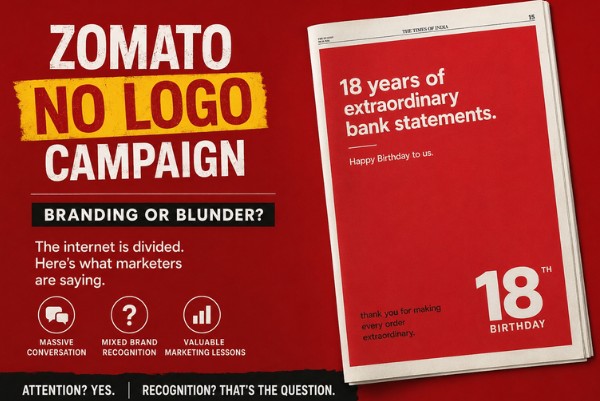
The Zomato No Logo Campaign has become one of the most debated print advertising campaigns in recent months. To celebrate its 18th birthday, Zomato released a full-page newspaper advertisement without its logo, trusting consumers to recognise the brand through colour, copy and familiarity alone. Some marketers called it a bold branding move. Others argued it exposed the limits of relying on colour as a distinctive brand asset. The divided reaction makes this campaign an excellent lesson for MBA students preparing for marketing interviews.
Marketing Lesson: What the Zomato No Logo Campaign Really Teaches
One of the fundamental principles of branding is building distinctive brand assets. Over time, consumers should begin recognising a brand through its colours, tone of voice, typography or visual style, even before seeing the logo.
Zomato’s birthday advertisement put this theory to the test.
The campaign removed the logo and challenged consumers to identify the brand. The internet quickly accepted the challenge, but the answers were anything but unanimous.
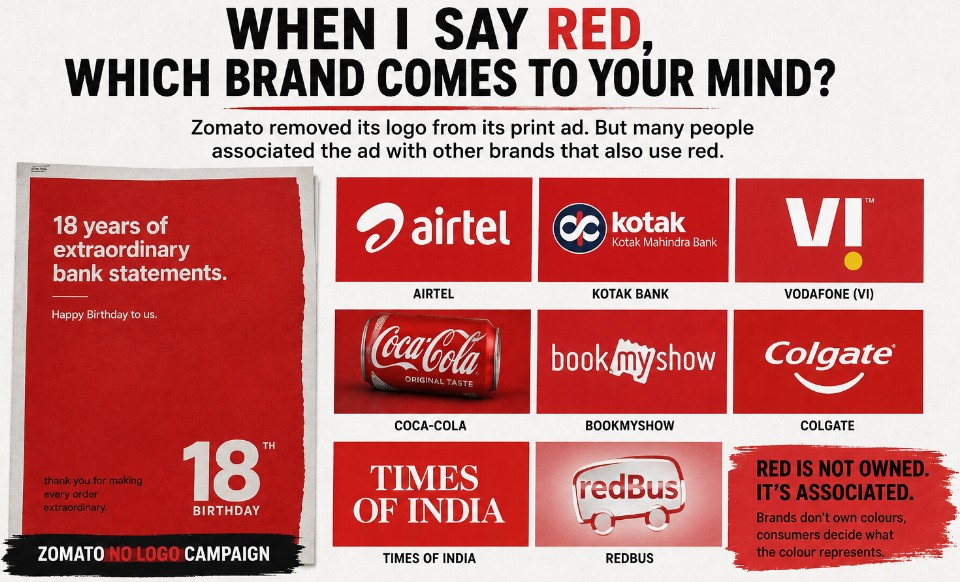
Many recognised Zomato immediately. Many others confidently guessed Kotak Bank, Airtel, Vodafone (Vi), BookMyShow, Coca-Cola, Times of India, RedBus, Colgate and several other brands. In many cases, people admitted they recognised it only because someone had tagged Zomato in the discussion.
That raises an interesting marketing question.
Did the campaign demonstrate strong branding, or did it reveal that Zomato’s distinctive brand assets are still evolving?
Here’s a simple classroom experiment.
Ask five people:
“Which brand comes to mind when I say the colour red?”
If everyone immediately says Zomato, the campaign has achieved what it intended.
But if the answers include Coca-Cola, Airtel, Kotak Bank, Vodafone, Colgate or BookMyShow, then the campaign highlights an important marketing reality.
Brands don’t own colours. Consumers decide which brand they associate with a colour.
That is exactly why the campaign generated such different opinions.
Another important distinction emerged from the debate.
The campaign undoubtedly captured attention.
Whether it achieved instant brand recognition is where opinions differed.
As marketers, we often use these terms interchangeably. This campaign reminds us they are not the same.
Social Media Debate on the Zomato No Logo Campaign (Qualitative Analysis)
Based on representative discussions across X (including posts by Gabbar Singh with 1.4M followers and Amit Kilhor with 82.3K followers), Reddit and marketing publications such as BestMediaInfo, Moneycontrol and Social Samosa. This is a qualitative summary, not a scientific survey.
| Sentiment | Typical Reactions |
|---|---|
| Positive | “Bold branding.” “Only a confident brand can remove its logo.” “People are talking, so it worked.” |
| Negative | “I thought it was Kotak.” “Looks like Airtel.” “Without the tag, I wouldn’t have guessed Zomato.” |
| Balanced | “Great conversation starter, but does conversation automatically mean brand recognition?” |
Brands Consumers Guessed Instead of Zomato
| Brand | Why It Came to Mind |
|---|---|
| Kotak Bank | Red branding + “bank statements” reference |
| Airtel | Strong association with the colour red |
| Vodafone (Vi) | Similar visual identity |
| Coca-Cola | Iconic use of red |
| BookMyShow | Frequently mentioned in discussions |
| Times of India | Newspaper context and layout |
One interesting observation is that many supporters measured success by the amount of conversation the campaign generated. Critics measured success by how quickly consumers recognised the brand. Both viewpoints evaluate different marketing objectives, which explains why the debate became so polarized.
Think Like a Marketer
Imagine you are Zomato’s Brand Manager.
Would you celebrate the fact that millions discussed the campaign?
Or would you worry that many consumers remembered another brand before remembering yours?
If a campaign generates exceptional attention but divided brand recognition, would you still consider it successful?
There isn’t a single correct answer.
That’s what makes this such a valuable marketing case study.
How to Use the Zomato No Logo Campaign in Placement Interviews
Typical Interview Question
“Can you discuss a recent campaign that divided marketing opinion?”
How You Can Answer
The Zomato No Logo Campaign is a strong example. By removing its logo from a newspaper advertisement, Zomato tested whether consumers could identify the brand through its distinctive assets alone. The campaign generated extensive discussion across social media and marketing publications. However, many consumers initially associated the advertisement with brands such as Kotak Bank, Airtel and Coca-Cola. This makes the campaign an excellent example of the difference between attention, brand recognition and distinctive brand assets.
Bonus Interview Tip
Avoid saying a campaign was simply “good” or “bad.” Instead, ask which marketing objective you are evaluating. A campaign can perform exceptionally well on one objective while producing mixed results on another.
Final Takeaway
The strongest brands don’t decide whether their assets are distinctive. Consumers do.