Introduction
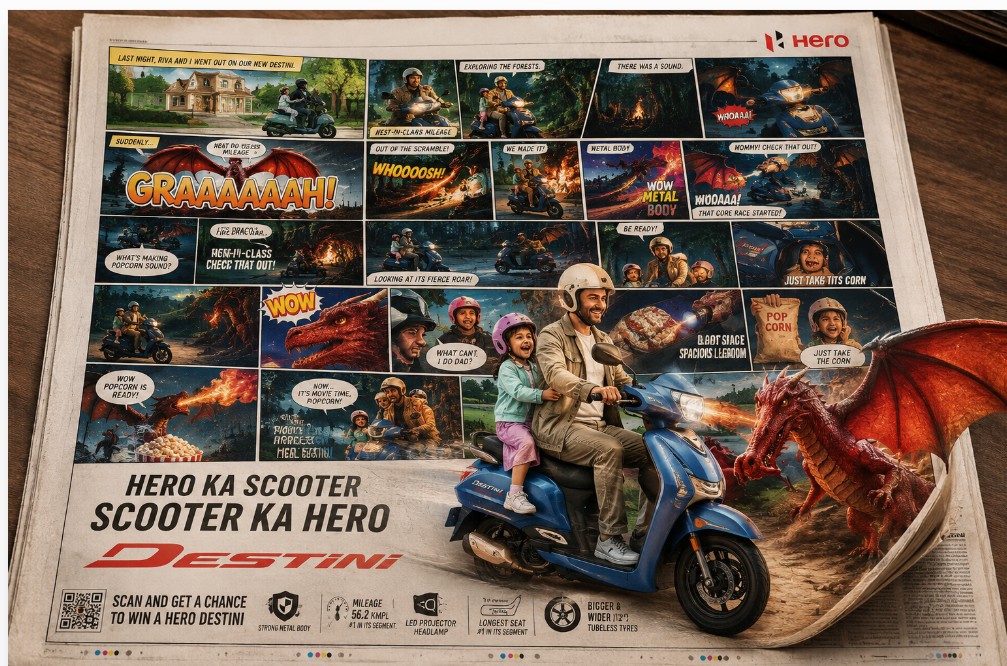
The Hero Destini Print Advertising campaign asks a fascinating marketing question. Why would a scooter brand transform a traditional newspaper advertisement into a comic strip complete with dragons, adventures and QR-enabled interactions? In an era where most readers quickly skim through newspapers, Hero chose to make people stop, read and even play with the advertisement.
The real lesson isn’t about creativity alone. It’s about Interactive Print Advertising and how brands can increase consumer engagement by changing the way people experience a newspaper advertisement.
Hero Destini Print Advertising Marketing Lesson
Before evaluating the execution, marketers should first ask a simple question:
What was Hero trying to achieve?
The objective wasn’t merely to showcase the scooter’s specifications. Hero wanted readers to spend time with the advertisement.
Today’s biggest challenge in Print Advertising isn’t reach. It’s attention.
Most newspaper readers either scan headlines or skip full-page advertisements altogether. Hero addressed this problem by borrowing a familiar format from childhood: the comic book.
Instead of presenting mileage, storage space and build quality in separate product boxes, the advertisement wrapped every feature inside an adventure. A father and daughter ride their new Destini scooter through a forest, encounter a dragon, escape danger and even use the scooter’s boot space to make popcorn after the dragon’s fire conveniently pops the kernels. Product features such as best-in-class mileage, spacious boot and strong metal body become part of the story rather than interruptions.
This is an excellent example of Interactive Print Advertising.
The interaction doesn’t necessarily come from technology. It begins with participation. Readers move panel by panel, follow the storyline and actively discover product benefits instead of passively reading specifications. In some editions, peel-out stickers further extended the experience, while others offered a QR code leading readers to the complete film, creating a bridge between print and digital.
From a consumer behaviour perspective, this approach increases dwell time. The longer someone spends with an advertisement, the greater the opportunity for the brand message to be remembered.
Think about it. When was the last time you finished reading every frame of a newspaper advertisement? Hero understood that attention has become the scarcest resource, and stories are one of the best ways to earn it.
Best Print Advertisements in India
Think Like a Marketer
If Hero had printed a conventional full-page advertisement listing mileage, engine capacity and price, would you have spent two minutes reading it?
Would the comic format work equally well for a bank or an insurance company?
At what point does an engaging advertisement become so entertaining that consumers remember the story but forget the brand?
These are the questions marketers should ask before deciding whether a creative execution has truly succeeded.
Memorable Indian Advertisements
How to Use Hero Destini Print Advertising in Placement Interviews
Typical Interview Question
How can traditional print advertising remain effective in a digital-first world?
How You Can Answer
Traditional media doesn’t have to remain traditional in execution. Hero Destini demonstrates that Print Advertising can still capture attention by making readers participate. Rather than competing with digital media on speed, it competes through immersion, storytelling and interactive experiences that encourage longer engagement.
Bonus Interview Tip
Differentiate between creative advertising and interactive advertising. Creativity attracts attention, but interaction keeps consumers engaged long enough for the brand message to be absorbed.
Final Takeaway
The future of Print Advertising may not depend on printing more ads. It may depend on creating advertisements that people actually want to read.
Check these best Advertisement Slogans
Also, ,look at the recent zomato print ad.

Professor of Marketing at Jaipuria Institute of Management, Lucknow. Ph.D. in Marketing, IIM Lucknow. Ex-assistant Prof at IIM Ranchi, visiting faculty to IIM Lucknow. Writes for ET BrandEquity, Campaign India, BusinessWorld, Times of India etc.