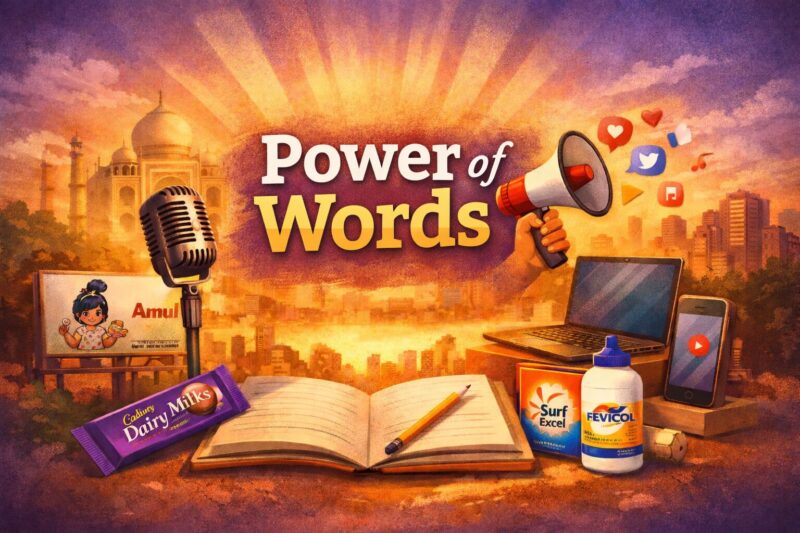
Indian advertisement slogans in Hindi have played a powerful role in shaping the country’s advertising landscape. From emotional storytelling to cultural resonance, these Indian advertisement slogans and Hindi taglines have shaped brands connect deeply with Indian audiences.
दाग अच्छे हैं।
कुछ ख़ास है ज़िंदगी में।
ये दिल मांगे मोर।
Three short lines. Three very different brands. Yet each of them proves one thing clearly: in Indian advertising, the right words can travel far beyond the ad itself.
This list of Hindi advertisement taglines also includes some of the most popular Indian advertisement slogans in Hindi that people still remember today.
As someone who teaches advertising and brand communication, I often tell my students: a great tagline doesn’t just describe a brand — it becomes part of popular culture.
Over the years, Indian brands have crafted Hindi slogans that are memorable, emotional, and deeply rooted in everyday life. In this article, we explore some of the most iconic Indian advertisement slogans in Hindi — along with why they worked and what marketing students can learn from them.
Words have always mattered in advertising, but in India, they do something more. They stay. They repeat themselves in everyday conversations. They quietly become part of culture. That is why Hindi advertising taglines continue to hold power, even as media platforms, formats, and technologies keep changing.
Why Hindi Taglines Work So Powerfully in Indian Advertising
The success of Indian advertisement slogans in Hindi lies in their emotional familiarity and cultural depth. Before we jump into the list, let’s understand something fundamental.
Hindi (and regional languages) create:
-
Emotional intimacy
-
Cultural familiarity
-
Higher recall value
-
Stronger festive and family associations
People may transact in English, but they feel in their mother tongue.
From a psychological perspective:
-
Native language improves memory encoding.
-
Emotional words in Hindi trigger stronger associative recall.
-
Cultural phrases become conversational assets.
In simple classroom language:
A Hindi tagline doesn’t just sit on a billboard — it sits in conversations.
Indian Advertisement Slogans in Hindi (Most Popular Examples)
If you are looking for Indian advertisement slogans in Hindi, many of these iconic taglines have become part of everyday language. These slogans are not just catchy phrases but powerful marketing tools that built strong brand recall.
25 Iconic Indian Advertisement Slogans in Hindi (With Meaning & Analysis)
1. Cadbury Dairy Milk – “Kuch Achha Ho Jaaye, Kuch Meetha Ho Jaaye”
Meaning: Let something good happen, let’s have something sweet.
Why It Worked:
Cadbury connected chocolate with celebration and positivity. In India, “meetha” symbolizes happiness. The tagline didn’t sell chocolate — it sold moments.
Marketing Lesson: Associate your brand with emotional rituals.
2. Surf Excel – “Daag Achhe Hain”
Meaning: Stains are good.
Why It Worked:
Brilliant reverse psychology. Surf Excel reframed stains as symbols of learning and kindness. Indian parents didn’t just buy detergent — they bought moral storytelling.
Marketing Lesson: Reposition the problem as a virtue.
(And yes, apparently in India, stains are now educational tools.)
3. Fevicol – “Mazboot Jod Hai”
Meaning: Strong bond.
Why It Worked:
Simple. Direct. Universal. Fevicol didn’t complicate its message. The humor in its ads strengthened recall, but the tagline remained consistent for decades.
Marketing Lesson: Simplicity builds longevity.

4. Tata Tea Premium – “Desh Ki Chai”
Meaning: The nation’s tea.
Why It Worked:
Tea is emotional in India. By linking tea to national identity, Tata Tea elevated a daily habit into cultural pride.
Marketing Lesson: Tie product usage to identity.
5. Axis Bank – “Dil Se Open”
Meaning: Open from the heart.
Why It Worked:
Banking is about trust. The word “Dil” evokes warmth and approachability — rare in financial services advertising.
Marketing Lesson: Humanize serious categories.
6. HDFC Life – “Sar Utha Ke Jiyo”
Meaning: Live with your head held high.
Why It Worked:
Insurance is abstract. This tagline made it aspirational. It appealed to dignity and empowerment — strong Indian values.
Marketing Lesson: Sell emotional outcomes, not financial products.
7. Parle-G – “Bachpan Se Bada Koi School Nahin”
Meaning: No school is bigger than childhood.
Why It Worked:
Pure nostalgia. Parle-G reinforced its identity as India’s childhood biscuit. Nostalgia is one of the strongest emotional triggers in marketing.
Marketing Lesson: Memory is a branding asset.
8. Ghadi Detergent – “Pehle Istemaal Karein, Phir Vishwas Karein”
Meaning: Try it first, then trust it.
Why It Worked:
Direct and confident. It addressed middle-class skepticism head-on.
Marketing Lesson: Remove purchase hesitation with clarity.
9. Vivo – “Jio Dil Se”
Meaning: Live from the heart.
Why It Worked:
Smartphones are about self-expression. This tagline connected technology with emotional living.
Marketing Lesson: Connect functional products with emotional benefits.
10. Amul – Topical Hindi Wordplay with “Utterly Butterly Delicious”
Why It Worked:
Amul’s clever Hindi puns on current events keep it culturally relevant. The brand doesn’t just advertise — it comments on society.
Marketing Lesson: Humor increases shareability.
11. Pepsi – “Yeh Dil Maange More”
Meaning: The heart wants more.
Youthful. Energetic. It became a cultural phrase beyond advertising.
Lesson: Great taglines enter everyday language.
12. Thums Up – “Taste the Thunder”
Often blended with Hindi storytelling.
Lesson: Consistent positioning builds masculine identity branding.
13. LIC – “Zindagi Ke Saath Bhi, Zindagi Ke Baad Bhi”
Meaning: With you in life and after life.
A masterclass in emotional reassurance.
Lesson: Security sells when expressed poetically.
14. Asian Paints – “Har Ghar Kuch Kehta Hai”
Meaning: Every home tells a story.
Brilliant emotional storytelling that moved beyond paint.
Lesson: Sell narrative, not product features.
15. Hero Honda – “Desh Ki Dhadkan”
Meaning: The nation’s heartbeat.
Strong masculine and patriotic positioning.
Lesson: Positioning can dominate a category.
(You can add 3–5 more later to expand toward 20–25 gradually.)
What Marketing Students Should Learn from These Taglines
After analyzing these iconic Hindi advertisement slogans, here are five clear lessons:
1. Simplicity Wins
The best taglines are short, clear, and conversational.
2. Emotional Positioning Beats Rational Claims
Nobody remembers technical specifications. They remember feelings.
3. Cultural Relevance Builds Recall
Festivals, family values, nostalgia — Indian advertising thrives on culture.
4. Consistency Creates Memory
Fevicol, Surf Excel, LIC — decades of consistent messaging.
5. Humor Is a Strategic Tool
When used well (like Amul), humor strengthens brand stickiness.
Why Indian Advertisement Slogans in Hindi Are So Powerful
Frequently Asked Questions About Hindi Advertisement Taglines
What makes an Indian advertisement slogan memorable?
Clarity, emotional resonance, cultural connection, and repetition make a tagline memorable.
Why are Hindi taglines more effective in India?
Hindi creates emotional familiarity and stronger recall compared to purely English slogans.
Can a tagline improve brand recall?
Yes. A strong tagline acts as a mental shortcut for brand identity.
How long should a good tagline be?
Ideally under 7–8 words. Brevity improves memorability.
What are the most famous Indian advertisement slogans in Hindi?
Some of the most famous Indian advertisement slogans in Hindi include “Daag Achhe Hain”, “Thanda Matlab Coca-Cola”, and “Yeh Dil Maange More”. These slogans became memorable due to strong storytelling and emotional connection.
You can also explore more iconic Hindi advertisement taglines that have shaped brand recall over the years.
Final Thoughts
Indian advertising has mastered the art of blending culture, emotion, and simplicity through powerful Hindi slogans.
A tagline may look small on a billboard — but in reality, it carries the weight of brand positioning, psychology, and years of consistency.
And as I tell my students:
If your tagline cannot be remembered after one exposure, it is not a tagline — it is a sentence.

Professor of Marketing at Jaipuria Institute of Management, Lucknow. Ph.D. in Marketing, IIM Lucknow. Ex-assistant Prof at IIM Ranchi, visiting faculty to IIM Lucknow. Writes for ET BrandEquity, Campaign India, BusinessWorld, Times of India etc.