Introduction
Good advertising can make people notice a brand. But it cannot make them stay. This is where many marketers and students get confused. We often assume that a powerful campaign can fix weak sales, poor products, or bad business decisions. The truth is simple. Good advertising cannot save a bad business. Many Indian advertisement slogans in Hindi are memorable, but not all of them translate into long-term business success.
The Myth: Advertising Can Fix Everything
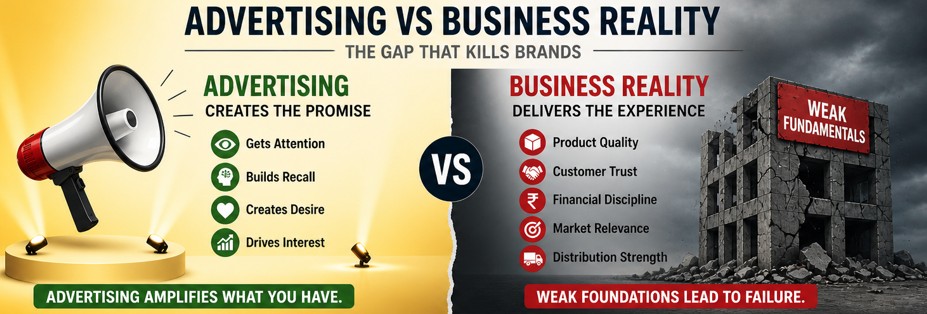
There is a common belief in marketing: “If the product is not selling, improve the advertising.” Sounds logical, but it is incomplete. Advertising can create awareness, build recall, and generate interest. But it cannot fix a bad product, repair broken trust, or solve financial problems. Advertising is an amplifier. If the core business is weak, advertising only amplifies the weakness faster.
Case 1: Rotomac Pens – Strong Ads, Weak Foundations
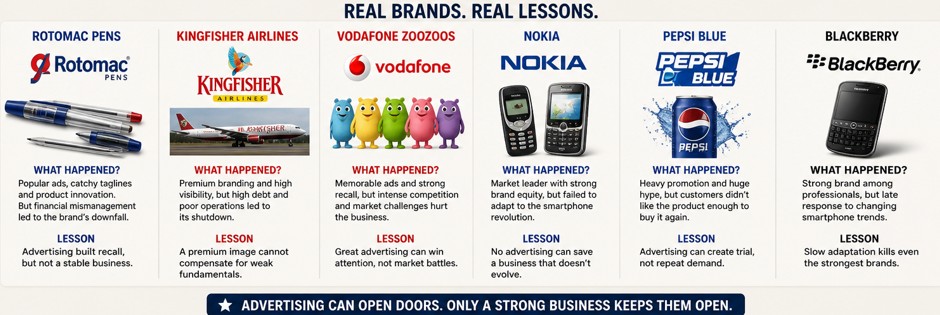
Rotomac is a perfect Indian example. You can read more about what happened to Rotomac pens in detail. In the 1990s, the brand became popular with celebrity endorsements, catchy taglines like “Likhte likhte love ho jaye,” and product innovation such as transparent pens. The advertising worked and people remembered the brand. But the business did not sustain. Financial issues, loan defaults, and mismanagement led to its downfall and the brand disappeared from the market. The lesson is clear. Advertising built recall, but it could not build a stable business.
Case 2: Kingfisher Airlines – Premium Branding, Broken Reality
Kingfisher positioned itself as a premium airline with a luxury experience, stylish branding, and strong visibility through sports and sponsorships. Everything looked aspirational. But behind the brand there was high debt, poor financial discipline, and operational inefficiencies. The gap between brand promise and business reality became too large and the airline shut down. A premium image cannot compensate for weak fundamentals.
Case 3: Vodafone ZooZoos – Memorable Ads, Complex Business Challenges
The ZooZoo campaigns by Vodafone are still remembered for their simple characters and unique storytelling. The ads had high recall value and were widely loved. However, the telecom industry faced intense price competition, regulatory pressure, and constant disruption. Vodafone later struggled financially despite strong brand recall. Great advertising can win attention, but it cannot control market forces.
Case 4: Nokia – Strong Brand, Weak Adaptation
Globally, Nokia was one of the strongest brands in mobile phones with memorable campaigns, trust, and massive market share. But the company failed to adapt to the smartphone revolution. Competitors changed the market and consumer expectations rapidly. Despite strong brand equity, Nokia lost relevance. No amount of advertising can save a business that fails to evolve.
Case 5: Pepsi Blue – High Hype, Low Product Acceptance
Pepsi launched Pepsi Blue with heavy promotion, celebrity endorsements, and curiosity-driven campaigns. People tried the product, but they did not like it enough to continue buying it. The product failed despite strong advertising. Advertising can create trial, but only product experience creates repeat demand.
What Actually Builds a Strong Business
If advertising is not enough, what really matters? Product quality ensures customers return. Trust and credibility sustain long-term relationships. Financial discipline keeps the business stable. Market fit ensures relevance. Distribution ensures availability. These are the real drivers of success.
Where Advertising Actually Fits
Advertising plays an important role, but it has limits. It works best when the product is strong, the business model is stable, and the brand promise is real. In such cases, advertising accelerates growth. Without these, it only delays failure.
A Simple Way to Think About It
Think of advertising like a microphone. If the message is strong, it becomes louder. If the message is weak, the weakness becomes louder. Advertising does not change the message. It only amplifies it.
Conclusion
So, can good advertising save a bad business? The answer is no. Even memorable Indian advertisements cannot save a business if the fundamentals are weak. It can create temporary visibility and short-term curiosity, but it cannot replace product quality, business discipline, or market relevance. The real lesson for marketers is simple. Build a strong business first, then use advertising to scale it. Not the other way around.

Professor of Marketing at Jaipuria Institute of Management, Lucknow. Ph.D. in Marketing, IIM Lucknow. Ex-assistant Prof at IIM Ranchi, visiting faculty to IIM Lucknow. Writes for ET BrandEquity, Campaign India, BusinessWorld, Times of India etc.