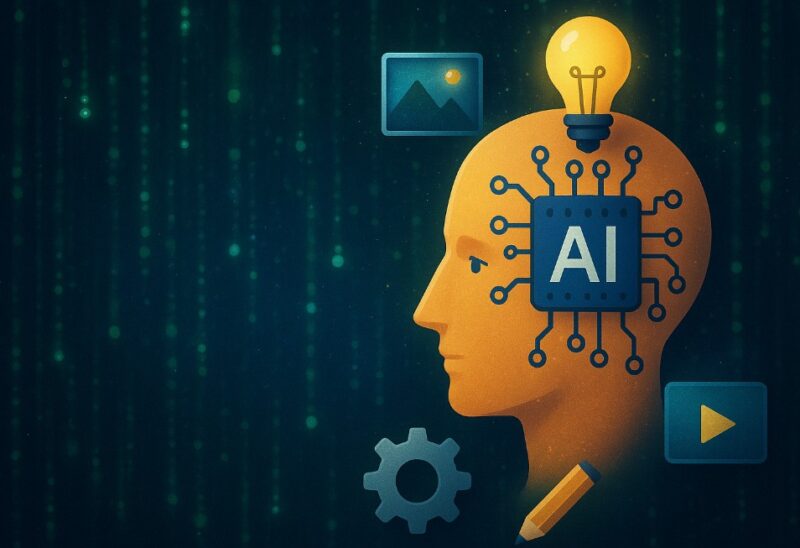
AI has entered advertising faster than most people expected. A few years ago, using AI in the creative process sounded like something for the distant future. Today, almost every creative team has tested an AI tool, used one quietly, or built entire campaigns with its support. The real question is no longer whether AI will influence ideas, but how it is already shaping the creative process in advertising.
The shift is clear: AI in the creative process is not replacing human creativity but expanding what creative teams can do with the same amount of time, or sometimes a fraction of it.
Why AI Matters in the Creative Process Today
Advertising thrives on fresh ideas, speed, and cultural relevance. AI helps with all three. When tight deadlines, endless briefs, and last-minute changes are the norm, AI brings structure, quick thinking, and options that help teams avoid the classic “blank page panic.”
And unlike the intern who needs three coffees to start the day, AI is always ready.
Brands in India — from Zomato and Swiggy to Tata, Cadbury, and Tanishq — are already using AI to support campaigns, test concepts, and understand consumer behaviour more precisely.
How AI Enhances Creativity, Not Replaces It
The biggest misconception is that AI steals creative jobs. In reality, AI in the creative process enhances what humans already do well. Think of it as a fast, tireless brainstorming partner who may not fully get Indian humour but can still speed up the journey to stronger ideas.
Creatives still make the final call. AI simply provides more raw material, more variations, and more insights than any single human could produce under pressure.
Faster Ideation With AI Tools
Tools like ChatGPT, Midjourney-style visual generators, and script-assist tools help copywriters and designers explore directions they might not have reached otherwise.
Need ten headline variations? AI can give you fifty.
Need a storyboard mock-up? AI produces one in minutes.
Need a fresh thought for an ad film? AI offers a base you can refine.
For agencies working on multiple pitches, AI in the creative process is becoming as essential as Photoshop or a strong cup of tea.
Data-Driven Insights in the Creative Process
AI does something human creatives cannot: it reads massive volumes of data, spots patterns, and predicts trends. This becomes extremely valuable when developing insights for campaigns.
For example:
-
AI can analyse conversations around Diwali gifting to show how consumer sentiment is shifting.
-
It can study thousands of social media posts to suggest what tone of voice may resonate with Gen Z.
-
It can track color, layout, and keyword performance across categories.
This speeds up the insight-finding stage, allowing creative teams to focus on storytelling and emotional depth.
How AI Supports Design and Content Creation
Visual creation is one of the biggest transformations. AI can now help generate layouts, social media concepts, product visuals, and even early versions of print ads. While final creatives still need refinement, AI eliminates hours of manual trial and error.
Indian brands experimenting with AI visuals are learning quickly: the tool is powerful, but human judgement is essential. AI can draw a perfect laddoo, but only a human understands what a laddoo means in an Indian cultural moment.
Voiceovers, video edits, and script drafts are also areas where AI is helping teams move faster, letting creators spend more time refining quality rather than producing volume.
The New Collaboration: Humans and AI in Advertising Agencies
Most creative teams now work in a blended style — human ideas supported by AI tools. Art directors, copywriters, planners, and designers use AI as part of everyday workflows.
A popular line in agencies today is:
“AI won’t take your job, but someone using AI might.”
It captures the truth. AI has become a skill, not a threat.
Young professionals who learn how to use AI in the creative process gain an advantage in brainstorming, pitching, and producing sharp early drafts that impress clients.
Where AI Still Falls Short in the Creative Process
For all its speed, AI lacks human nuance. It struggles with:
-
Cultural insights
-
Emotional authenticity
-
Sarcasm and Indian humour
-
Long-term storytelling
-
Understanding the difference between clever and meaningful
AI can remix what it has seen before, but truly original thinking still starts in the human mind. India’s funniest Amul ads, most moving Tata Tea campaigns, and boldest Fevicol ideas come from lived experiences, not algorithms.
This is why AI in the creative process works best when guided by strong human judgement.
What This Means for the Future of Advertising Creativity
AI is becoming a natural part of creative work — not a replacement, but an accelerator. The future looks less like “AI versus creatives” and more like “AI plus creatives,” with each playing a clear role.
Ideas will move faster.
Designs will take shape sooner.
Insights will become sharper.
And creative teams will have more time to focus on crafting stories that move people — something AI still cannot fully master.
Used intelligently, AI in the creative process can help the industry become more efficient, more experimental,

Professor of Marketing at Jaipuria Institute of Management, Lucknow. Ph.D. in Marketing, IIM Lucknow. Ex-assistant Prof at IIM Ranchi, visiting faculty to IIM Lucknow. Writes for ET BrandEquity, Campaign India, BusinessWorld, Times of India etc.